

JubAp.eu · Private Service Line
Capacity & Value Optimization
Evidence-based re-staffing, workload and application-cost optimization — the platform that turns cost pressure into a negotiation position.

The whole pitch, in one sentence
Do the same with 30% less capacity — or deliver 50% more value with the same budget.
Most technology, operations and transformation departments are pushed to cut cost before they have a defensible model of the capacity they actually need. Cutting blindly weakens delivery — and weakens the sponsor. This line gives the sponsor the evidence, and the choice.
The shift
From defensive cost-cutting to evidence-based negotiation
A manager who only proves they can do more with less weakens their own position. The same diagnostic, framed correctly, becomes a negotiation platform: operate with less waste, protect service continuity, and demonstrate where budget can create measurable value.
The pressure
Reduce cost, justify headcount, and deliver more with limited capacity — usually all at once.
The trap
Cut without an operating model and delivery breaks. Add headcount without a value case and budget pressure grows.
The evidence
Minimum effective capacity, built from real demand, real production, profiles, RACI, workload and application cost.
The position
A sponsor who can choose: meet the cost target, defend budget, request more, or reposition as a value generator.
The model · capacity · cost · value
Minimum effective capacity, then a choice
First we establish the minimum effective capacity required to deliver the current service. The budget that frees is not an answer — it is a decision the sponsor gets to make.
# Illustrative. Loaded cost ≈ €100k / FTE. Real figures are built from demand, production and workload evidence during the diagnostic.
What “minimum effective capacity” is built from
Not a benchmark and not a guess — a model assembled from what the work actually demands, so the target is defensible in front of a board and stable enough not to rebound.
What the sponsor receives
A minimum operating model they own and can defend: current vs. target headcount, proposed role profiles, task redistribution, an optimized RACI, reduction risks, savings scenarios, a transition plan and a reduction business case.
The service line · modules
Four moves, bought one at a time
One coherent practice, entered through whichever module matches the sponsor’s real pressure. Each can be bought alone; together they form a complete capacity-to-value path.
Headcount Optimization Diagnostic
“Can we deliver the same, or better, with less?”
Demand, production, tasks, profiles, RACI, workload, overlaps, low-value activity and bottlenecks.
A minimum operating model: current vs. target headcount, role profiles, savings scenarios, transition plan and business case.
Precision Re-Staffing Delivery
“How do we get the right profiles — without sliding back into over-staffing?”
Required profiles against the validated operating model; interim, fractional or managed-capacity options.
Sourcing, technical validation, shortlist, onboarding, early follow-up, and replacement if a profile does not fit.
Structural Stabilization & Governance
“Does the leaner structure actually hold, without degrading service?”
Monthly load, SLA, task validation, RACI adjustment, exceptions, productivity and early over-demand signals.
Executive reporting and adjustment recommendations over a defined period — proof the reduction is structural.
Application & Workload Rationalization
“How much capacity exists only because the tech landscape is mis-rationalized?”
Apps per role, time per app, data flows, duplication, manual tasks, weak integrations, legacy support, automation and AI fit.
An application–process–headcount map, rationalization and automation opportunities, cost reduction, roadmap and business case.
Diagnose
Establish minimum effective capacity from evidence.
Model
Design the target operating model and RACI.
Options
Release cost, or redirect budget to value.
Re-staff
Place precise capacity against the model.
Stabilize
Govern so the new structure holds.
Engagement model
Built around validated savings, not billed hours
The commercial logic mirrors the work: low-friction entry, fees that follow real evidence, and a transparent rule for when access is the constraint.
Diagnostic with skin in the game
If we do not identify a reasonable optimization opportunity, you pay only a minimum diagnostic fee. If we identify validatable savings, a success fee or a second phase activates. Low risk to enter, real incentive to be right.
Capacity against a model
Re-staffing is delivered as interim, fractional or managed capacity, validated against the operating model — with replacement if a profile does not perform. You are not buying people; you are buying fit.
Paid by the savings it protects
An annual stabilization fee linked to validated savings, so the recurring engagement is funded by the value it secures rather than by its own duration.
Fixed budget, explicit confidence
The budget can be fixed; the confidence reflects the access provided. Where stakeholder access or data is limited, the model states findings as validated, partially validated or assumption-based — never false certainty. Reserved-capacity terms cover genuine pauses.
We do not fill vacancies. We place capacity against a validated operating model.
A field example · capacity already paid for
The capability nobody had priced

A deprioritized queue-management feature
In a luxury operations context, a queue-management capability sat low in the backlog in central services. Reviewed with boutique managers across the value chain, it proved capable of meaningfully lifting sales at saturation peaks — a low-cost smart-scheduling API the organization could already reach. The value was not missing. It was simply never connected or priced.
≈ +30% sales at peak saturation · already within reach

Why we can model capacity
Across 2,500+ applications in 50 companies and hundreds of deep dives, we have learned the capacity a value chain really needs — and the capacity it only thinks it needs.A calibrated benchmark, not a textbook framework. When a team inflates the criticality of a minor tool, the pattern simply does not match — and the work is corrected on the spot.
Field evidence · documented in the JubAp.eu field notes
Operating-model work that held
The capacity practice is a continuation of real rationalization and operating-model work in complex multinational environments — luxury, manufacturing, logistics and infrastructure.
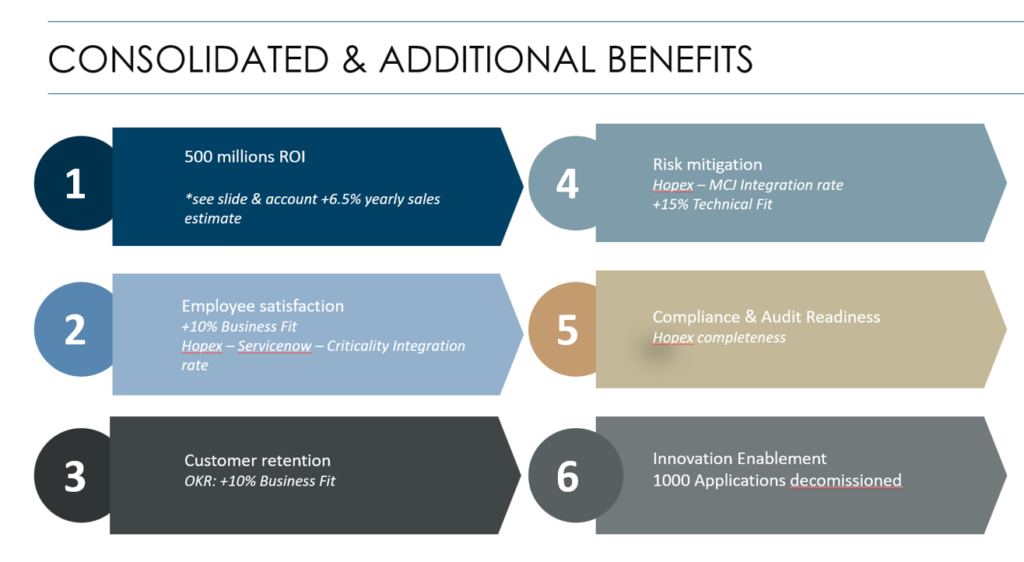
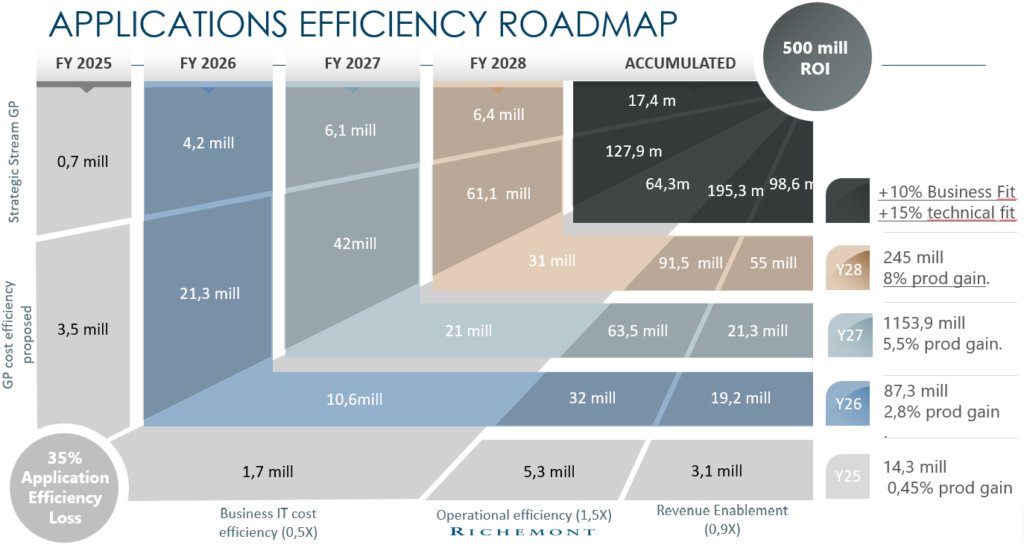
Rationalization across a decentralized luxury group
A three-year, Steering-level application-rationalization programme — building the group’s first architecture backbone and re-reading the portfolio as value, not only cost.
Supply-chain rationalization & process mining
Observability for high-value, multi-entity logistics — exposing where workload, applications and cost accumulate without creating value.
A leaner operating model under extreme pressure
A workforce facing extinction became the reason the airport was kept and reformed — operating-model change that held under real political and operational stress.

Watchmaking, Japan EA, luxury operations & more
Manufacturing rationalization, horizontal architecture governance, demand orchestration and overcompliance environments — the full body of capacity and rationalization work.
One practice, two doors
Some mandates start with cost. Others start with value.
Capacity & Value Optimization
Minimum effective capacity, re-staffing, workload and application-cost optimization. The operating-model and headcount door — for cost pressure, CFO mandates and restructuring.
— this service lineDiamond Inside
Backlog value & hidden-capability unlock: trapped business value validated across the internal value chain, released through capabilities already paid for. The positive door — for defending or redirecting budget.
See Diamond Inside →Diamond Inside tells us what value should be unlocked. Capacity & Value Optimization redesigns the operating model, applications and capacity needed to unlock it efficiently — so reduction, when it comes, is never blind.
Why us · a continuity, not a new idea
A natural lineage of the work
Architecture authority
Built on enterprise architecture, TBM and application-portfolio rationalization across multinational luxury, manufacturing and multi-entity technology landscapes.
Institutional backing
Developed within the frontier practice environment of The Integral Management Society / IMSV.org — Swiss governance, methodology and stewardship.
Execution network
Specialist and interim capacity can be coordinated through JubAp.us and its partner network, so delivery is never bottlenecked on a single person.
Offered by selective mandate · first conversation confidential
Bring the pressure. We’ll build the evidence.
A confidential conversation, then an entry diagnostic, tells you the minimum capacity your service really needs — and what the freed budget is worth, whether you choose to release it or redirect it.

Capacity & Value Optimization is a private service line held within the JubAp ecosystem and stewarded by The Integral Management Society / IMSV.org, a Swiss frontier institution based in Geneva. It is presented commercially through Rationalization.ai, with execution and specialist capacity coordinated via JubAp.us. It sits inside the wider JUBAP framework and the Human Intelligence Gap research line.