
A value-discovery methodology for decentralized, heritage-rich groups — finding the value already inside the landscape before deciding what to keep, scale or retire.
A JubAp / IMSV.org rationalization method · Field-proven on a 50+ Maison programme
Conventional rationalization counts applications. The expensive mistakes hide in what it doesn’t count.
Most rationalization programmes begin by listing systems and ranking them for cost. In a uniform organization that can work. In a decentralized, heritage-rich group it quietly destroys value, because the things that make such a group valuable — local excellence, cultural identity, hard-won adaptations — rarely show up on a portfolio list as anything other than «duplicates.»
This is the trap the Cost of Clarity work names precisely: the information you would need to rationalize safely is treated as free, when in fact it is costly and often missing. Declaring a clean target architecture and cutting toward it is not a safe cleanup — it is a blind bet against value you cannot see. Diamond Inside is the operational answer to that bet: pay the cost of clarity up front, understand why each capability exists, and only then decide.
The programme stops asking «what can we remove?» and starts asking «what value is already inside the group that we cannot yet see — and which of it is worth scaling?»
From cost reduction to value discovery
Diamond Inside treats the application landscape not as a cost baseline but as a global intelligence layer — thousands of solved and unsolved business problems, local innovations and cultural adaptations, most of which were never surfaced at group level.
Rationalize for value, not only cost
Saving money is a by-product; the aim is better investment quality and new value.
Diversity is optionality
Duplication can hide waste — or experimentation, adaptation and innovation. The job is to tell them apart.
Understand before deciding
Each application is the trace of a need, a culture, a metric, an outcome. Read it before you judge it.
Protect the DNA
Heritage capability is exactly what blind rationalization deletes. Identity that creates value must survive.
A local application that looks duplicative at first glance often exists for a very good reason. Diamond Inside is the discipline of finding that reason before acting on it.
Five moves, in order
Establish the backbone & the context
You cannot evaluate what you have not inventoried and understood. Diamond Inside assumes a real architecture backbone underneath it — a consolidated technology footprint where each application carries its criticality, owner, cost and service level. Without that substrate, every later decision is guesswork dressed as analysis.
Read each capability across nine dimensions
No application is judged on cost alone. Each is read across a deliberately broad lens, so that a system can be business-critical yet technically weak, or technically strong yet impossible to industrialize — and the difference becomes visible before a decision is made.
Classify into five honest outcomes
The reading resolves into one of five decisions — not a binary keep/kill. Most of the value of the method is in refusing the false choice between «standardize everything» and «leave everything alone.»
Apply the JUMP test to anything you mean to scale
A local success is not automatically a group capability. Before scaling, it must pass the JUMP filter. This is where Diamond Inside connects to the wider JUBAP method: scaling is only worthwhile when value can actually propagate.
Govern cross-functionally; produce Steering-level options
No single function can rationalize this kind of ecosystem alone. Finance, cybersecurity, legal, enterprise architecture, service management and the business sit in one decision frame, so complexity is translated into a small number of clear, defensible options for leadership.
Keep local · consolidate · scale · transform · retire
- Keep local — the capability reflects a genuine local need or expresses Maison identity. Preserve it; do not standardize it away.
- Consolidate — several solutions serve one real need. Collapse them into a shared capability without losing what mattered.
- Scale — a local innovation has value beyond its origin. Promote it to a group capability (after the JUMP test).
- Transform / merge — the business value is real but the architecture, ownership or funding is not yet sustainable. Re-platform or combine.
- Retire — the capability no longer creates value. Remove it and return the resources it was freezing.

JUMP — because a local success is not automatically a group capability
Before a capability is scaled across Maisons or regions, Diamond Inside runs it through the same filter JUBAP uses to decide whether any initiative can really move and is worth moving.
- J — Joinable — Will the other Maisons and regions actually adopt it? Is there willingness, ownership and cultural fit — or only a mandate?
- U — Unblocked — Do governance, legal, data-protection and security across jurisdictions permit it to proceed?
- M — Movable / Measurable — Is it technically scalable, with a credible TCO, a clear owner and a real support model — and can the effect be measured?
- P — Propagating — Does it create value beyond its origin Maison — for other Maisons, processes or, ultimately, the client?
JUM filters what can really move. P identifies what is worth moving because its value projects.
The practical answer to «cleaning up means betting blind»
The warning at the heart of the Cost of Clarity and Attribution Gap work is real: rationalizing toward a clean target without the information to see what you’re cutting destroys the capabilities a firm most depends on. Diamond Inside does not dispute that — it routes around it. By building the backbone, reading each capability in context, and separating the decision into five honest outcomes, it converts a blind bet into an informed one.
It also changes the deliverable. The output is not a shorter application list; it is a richer understanding of where value is created differently across cultures and business models, a methodology to preserve what is distinctive while scaling what is reusable, and a backbone the group can keep running itself. That is what makes large-scale rationalization a platform for innovation, capital efficiency and AI readiness rather than a quiet act of value destruction.
Field-proven on a 50+ Maison programme
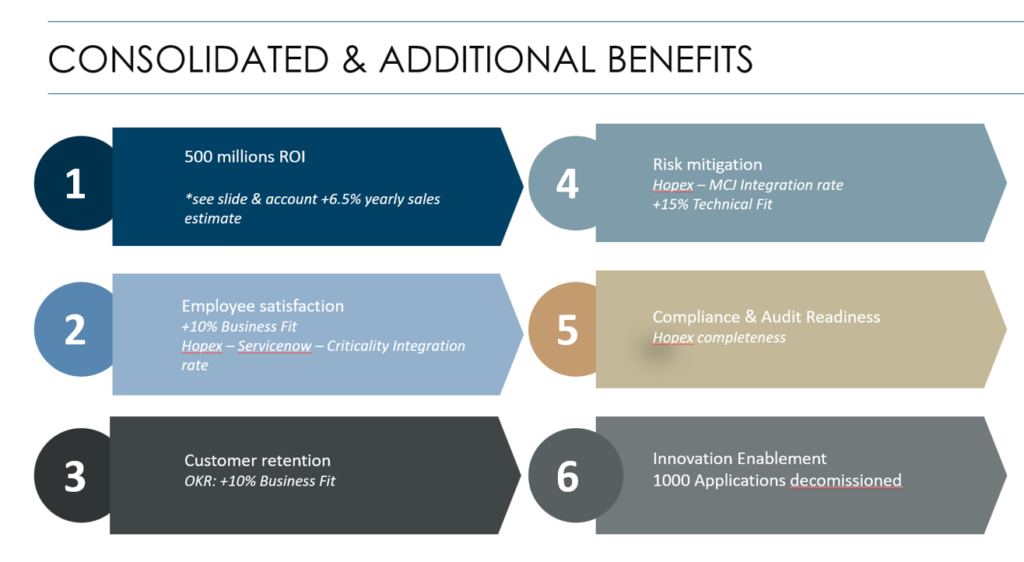
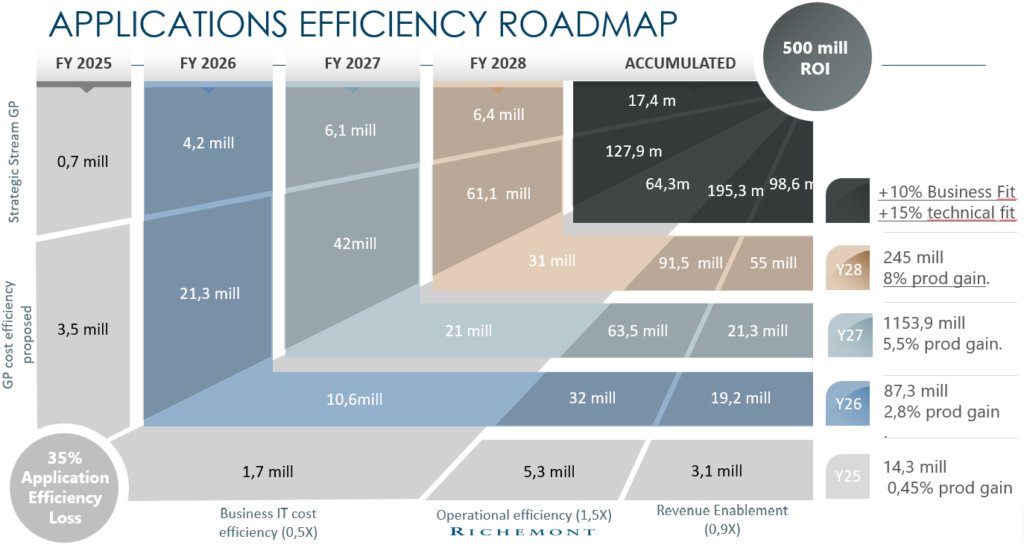
Diamond Inside was structured and field-proven on a three-year, Steering-level programme across 50+ Maisons — building the group’s first architecture backbone and reframing rationalization as value creation. The full account is in the Richemont case study.


Diamond Inside is a proprietary rationalization methodology held within the JubAp ecosystem and stewarded by The Integral Management Society / IMSV.org. It sits inside the wider JUBAP framework and the Human Intelligence Gap research line.
This article describes the firm’s proprietary methodology and its underlying logic. References to the 50+ Maison programme reflect the firm’s account of an engagement where the method was structured and later transferred to a Big Four firm for broader industrialization.
Explore more Case Studies