
Global application rationalization across a decentralized luxury group
A three-year, Steering-level programme across more than 50 Maisons — rationalizing the global application landscape to enable post-M&A integration and cross-Maison value, while preserving the heritage and identity of each house.
Enterprise architecture, rationalization & technology value creation · Stewarded by The Integral Management Society / IMSV.org
One of the Group’s four strategic programmes, delivered end-to-end.
A landscape that was not only large, but deeply heterogeneous
Richemont is not a conventional multinational. It is a constellation of more than 50 Maisons, legal entities, regional structures, manufacturing environments and retail networks, many with their own history, operating logic and — in some cases — centuries of accumulated organizational DNA. Over the years the Group’s balance between centralization and decentralization had shifted repeatedly, and each Maison had grown its own ecosystem of applications, local workflows and technology decisions.
The engagement began without the foundations most groups assume already exist: there was no Group-wide enterprise-architecture management system, and no consolidated multi-entity application inventory. Even the basic question — what counts as “an application”? — had to be defined before anything could be counted.
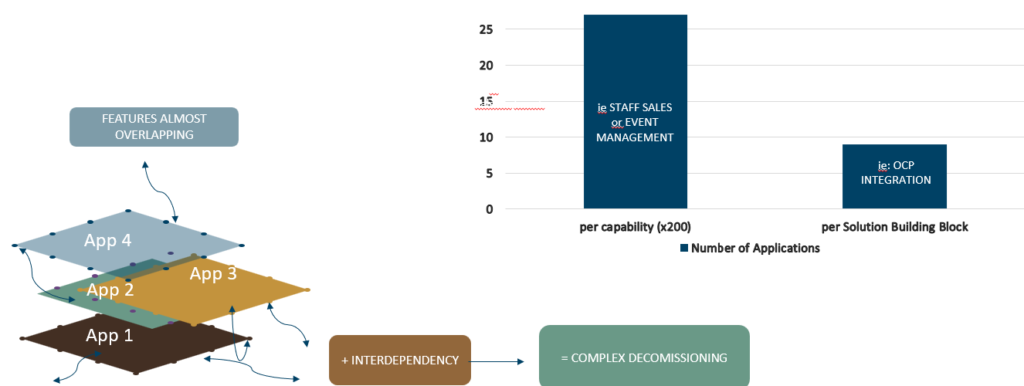
When discovery ran across every region, country and entity, an early finding was significant: the degree of duplication by capability was roughly three times higher than expected. That duplication was not always inefficiency. Much of it reflected genuine differences in customer expectations, local regulation, regional business models and Maison identity. This framed the central question of the programme:
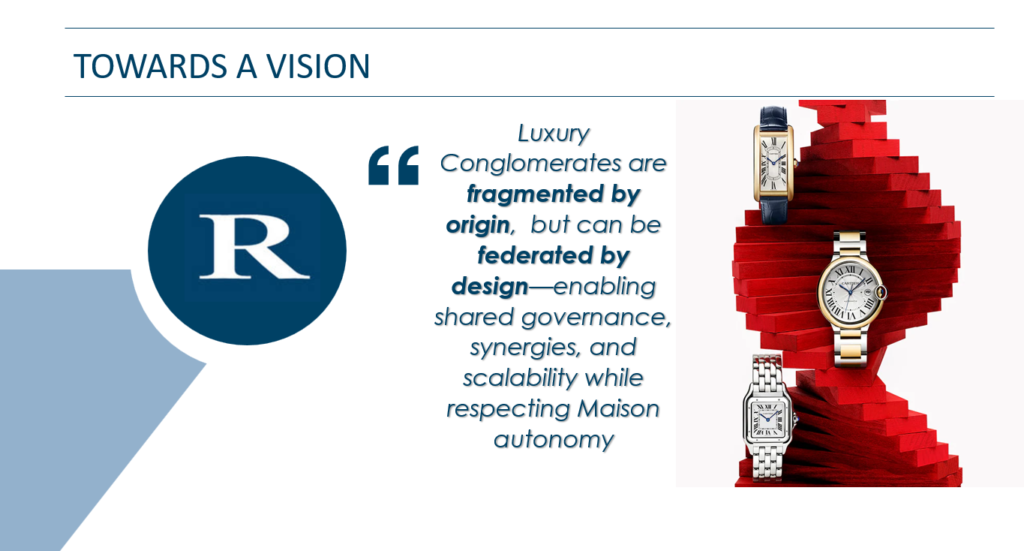
How to rationalize the Group’s technology while preserving the local distinctiveness from which each Maison derives its value.
Rationalize with intelligence, not by forced standardization
At first sight this could have been described as an application-rationalization initiative. In practice it was a portfolio transformation oriented toward value creation, selective scaling and organizational intelligence. The firm deliberately chose not to treat it as a centralization exercise.
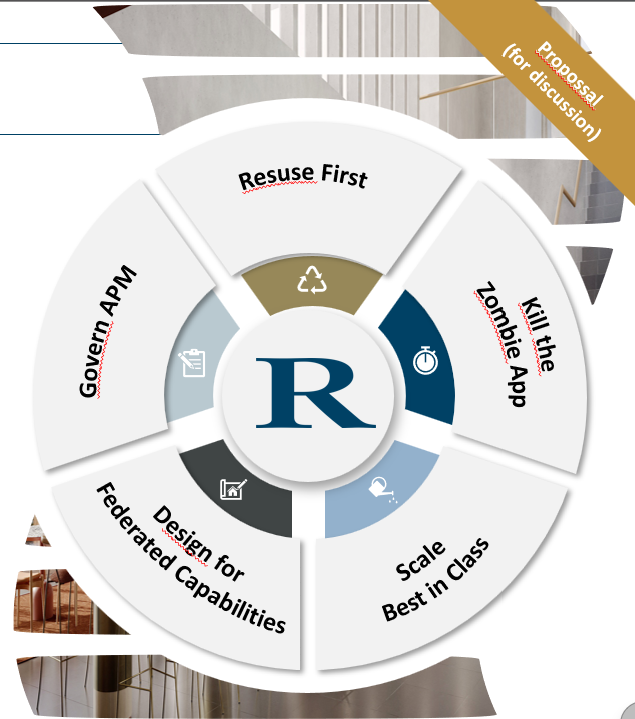
Standardizing too aggressively in a group of this kind would erode the cultural foundations and local-excellence models that are part of its value. The work was therefore held to a few clear principles, applied at Steering level across business, finance, cybersecurity, legal and architecture:
Rationalize for value, not only cost. The goal was to improve investment quality and create new value — not just to remove redundancy.
Preserve the heritage. Duplication is not the same as waste; some of it represents identity and capability built over decades, and must be retained.
Understand before deciding. Each application is the trace of a real business need — know why it exists before you keep, scale or retire it.
One cross-functional decision frame. No single function can rationalize this ecosystem alone; complexity has to become clear Steering-level options.
The question stopped being “what can we remove?” and became “what value is already inside the Group that we cannot yet see?”
Build the architecture, then make it create value
Build the backbone (EAMS & the first global footprint)
The firm built the Group’s first enterprise-architecture management system and embedded it as the operational backbone of Group technology. Starting from a clean definition of “application,” discovery ran across all regions, countries and 50+ entities, establishing the first consolidated global technology footprint the Group had ever held — and surfacing roughly three times more applications than anyone expected.
Integrate it into how the Group actually runs
The inventory was not left as a static list. Each application was connected to criticality and service levels, and integrated with cybersecurity, TCO and finance, service management, and delivery — IT-ops, cloud and the rest — across a multi-jurisdiction environment (China, the US, India and others) aligned to corporate governance, data protection and regulatory requirements. APM became a cross-functional integration layer linking SLA governance, cybersecurity, enterprise architecture and strategic-programme decisions.
Diamond Inside — the value-discovery decision lens
To decide what to keep local, consolidate, scale, transform or retire, the firm structured a proprietary Group methodology, Diamond Inside. Rather than counting applications, it read each one across multiple dimensions — turning diversity into optionality and distinguishing duplication that hides waste from duplication that hides experimentation, adaptation and innovation.
Process intelligence at Cartier → AI readiness
The signature initiative used process mining to understand how applications, processes and business outcomes actually interacted — not just what the inventory claimed. Several platforms were evaluated through pilots and PoCs (Salesforce, Signavio, Maia) before Celonis AgentC was deployed as the agentic execution layer. This moved the Group from a static application list toward dynamic technology intelligence, and made rationalization the preparation layer for AI-enabled operations.
Make it last — multi-level capability
The programme trained people across all regions to maintain the inventory and run a quality-management system for it in a single multi-group environment. The backbone was built not as a one-off audit, but as a living capability the Group could keep current itself.
The arc
Value that a portfolio list cannot show
A list of “duplicate” applications cannot show what makes each house distinctive. Treating diversity only as inefficiency would have removed precisely the capabilities the Group exists to protect.
Discovery surfaced capabilities built under specific cultures and constraints that a purely cost-driven review would have classified as redundant — for example heritage systems developed within individual Maisons, such as a founding house’s own calibration system, a significant capability in its own right; and highly specific approaches to clienteling, events, demand and technology across thousands of high-value, high-sensitivity products. To these add watchmaking and high-precision manufacturing environments whose quality-control demands match or exceed those of other advanced industries; inventory that must be tracked not only by where a piece is but where it should be for a specific client interaction; anti-counterfeiting and digital fingerprinting of individual pieces; and customer expectations that differ markedly between Japan, Europe, the United States and China.
A local application that appears duplicative often exists for sound reasons. The task was to distinguish the two rigorously.
Business value delivered
- First consolidated global technology footprint across 50+ Maisons and a much wider network of legal and operating entities.
- ~3× more applications per capability discovered than expected — treated as optionality and innovation, not only as cost.
- Maison culture and organizational DNA protected while still applying one common portfolio methodology.
- A structured APM / cross-functional layer connecting enterprise architecture, cybersecurity, finance, legal, service management and SLA governance into one decision frame.
- Improved CAPEX / OPEX decision quality through more rigorous TCO and ownership analysis.
- Rationalization linked to AI readiness via process mining and Celonis AgentC at Cartier.
- ~3× programme ROI by year three (firm’s account).
- Diamond Inside left in structured form and later transferred to a Big Four firm for broader industrialization.
The durable asset
The value created was not only immediate portfolio insight. It was a living architecture backbone and a decision model the Group could keep running — and a methodology robust enough to hand to a Big Four for continuation.
Rationalization as value creation
In a decentralized luxury group, rationalization cannot be a mechanical cost-cutting exercise. A luxury group does not create value through uniformity; it creates value through selective differentiation, exceptional experience, local excellence and the intelligent scaling of the right capabilities. The firm’s role was to help the Group distinguish diversity that creates value from diversity that creates friction — and to build the architecture and methodology that made that distinction repeatable.
Rationalization at this scale carries a real risk: decisions taken without sufficient visibility can remove capabilities the organization depends on. The discipline that avoids it is to establish the necessary clarity first — build the backbone, understand why each capability exists — and only then decide. That was the approach here, and it is the practical counterpart to the Cost of Clarity and Attribution Gap work in the Human Intelligence Gap series.
This engagement and the methodology behind it (Diamond Inside) are held within the JubAp ecosystem and stewarded by The Integral Management Society / IMSV.org.
Explore more Case StudiesThis account describes the firm’s role and contribution as enterprise-architecture and rationalization partner. Outcome figures — including the discovery of roughly three times more applications than expected and an approximate 3× programme ROI by year three — are drawn from the programme’s own records and reflect the firm’s account; they are presented as such. Maison and platform names are used to describe the engagement context. Companion pieces: the Discovery / EAMS-backbone case study and the Diamond Inside methodology article.