
Tegrity.AI·JubAp.EU
Car Evolution
An operationally tested mobility-orchestration product — validated as an MVP at scale and ready for European deployment and adaptation

Open the video directly if it does not play in your browser.
Car Evolution is an existing mobility-orchestration product that has already been tested as an MVP in large-scale daily operations.
Its underlying platform coordinated between 10,000 and 15,000 passengers per day and hundreds of buses, managing vehicles, schedules, travel preferences, access restrictions, CO₂ and service policies, hard and semi-flexible constraints, and continuous operational replanning.
In its current form, the product can already be offered commercially for defined B2B mobility-orchestration use cases, particularly bus and passenger-transport operations. European adaptation is highly advisable to address local regulation, integrations, data environments, user experience and additional market requirements; it is an extension and productisation step, not the creation of the first product or prototype.
The three questions
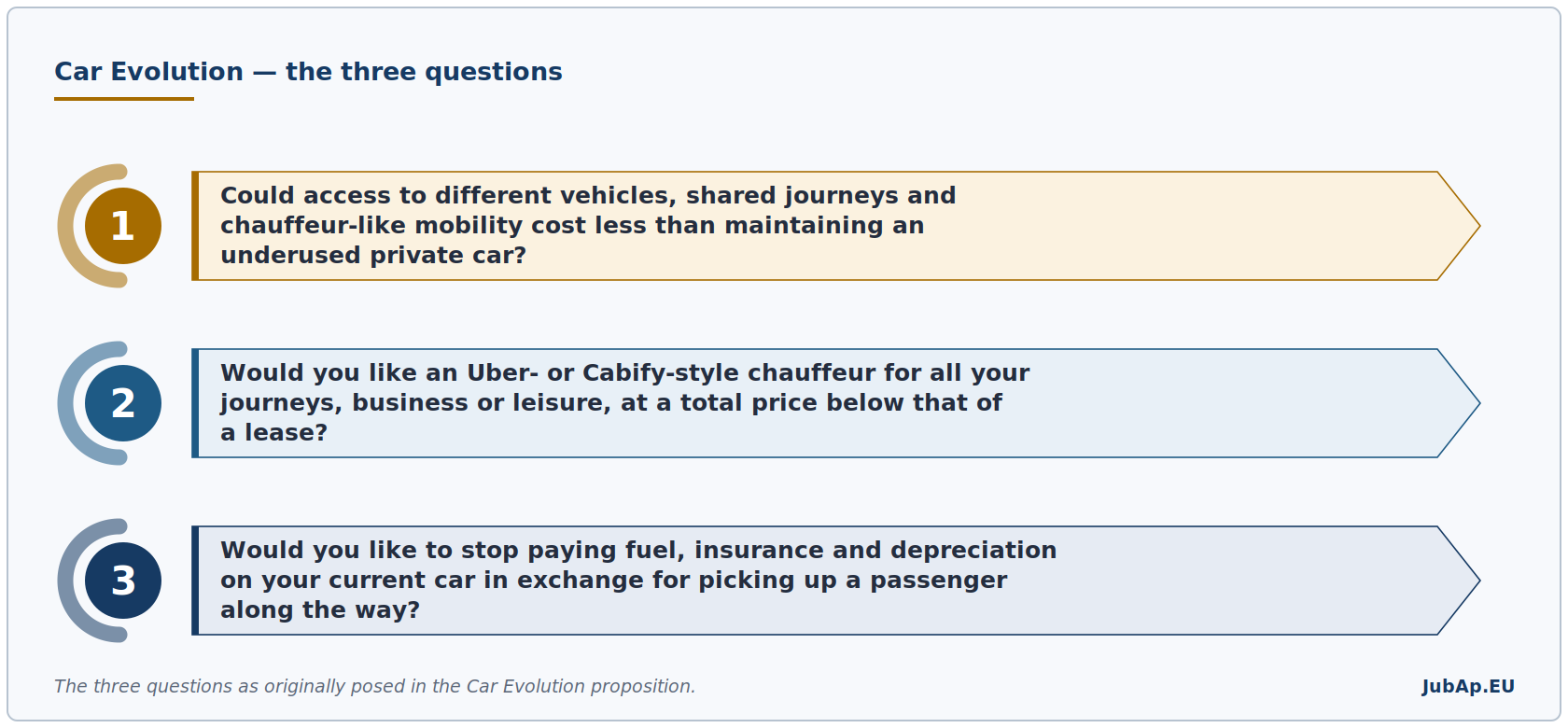
The original Car Evolution proposition opens with three questions put directly to the reader.
- Could access to different vehicles, shared journeys and chauffeur-like mobility cost less than maintaining an underused private car?
- Would you like an Uber- or Cabify-style chauffeur for all your journeys, business or leisure, at a total price below that of a lease?
- Would you like to stop paying fuel, insurance and depreciation on your current car in exchange for picking up a passenger along the way?
Operational product evidence
A mobility and logistics operating system tested as an MVP at operational scale.
This was not a narrow routing experiment. It operated as a full mobility and logistics operating system, coordinating public, private, contracted and third-party vehicles through one planning and execution environment. It supported vehicle and passenger preferences, permitted and restricted access zones, time windows, CO₂ policies, service-level commitments, hard and semi-flexible rules, dynamic optimisation, incident response and continuous route reconfiguration.
The product therefore entered its European phase with substantially more evidence than an untested concept or first prototype. Its core orchestration capability has already been built and used in real operations. The current opportunity is to commercialise that capability in Europe as-is where the existing configuration fits, while adapting and extending it where local customers, regulation and integrations make this commercially advantageous.
Beyond ordinary workshop and driver management, xSeil is distinguished by the artificial-intelligence algorithms that plan routes while respecting constraints and preferences:
- which travellers may travel with which others;
- vehicle types and their usage preferences;
- the zones each vehicle type may enter, and at which hours;
- CO₂ policies;
- maximum mileage and maximum number of stops per route;
- service-level agreements and maximum tolerable delay;
- traffic congestion.
From these it builds an optimal route plan for each vehicle and revises it as events occur through the day.
Before selecting xSeil, the client studied the systems available on the market and consulted competing suppliers, concluding that xSeil fitted these particular flexibility requirements better.
Evidence from the operating product
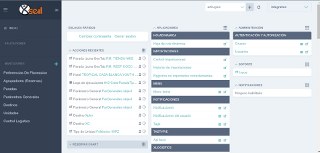
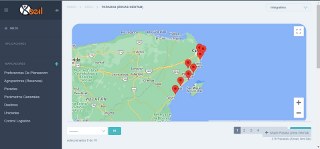
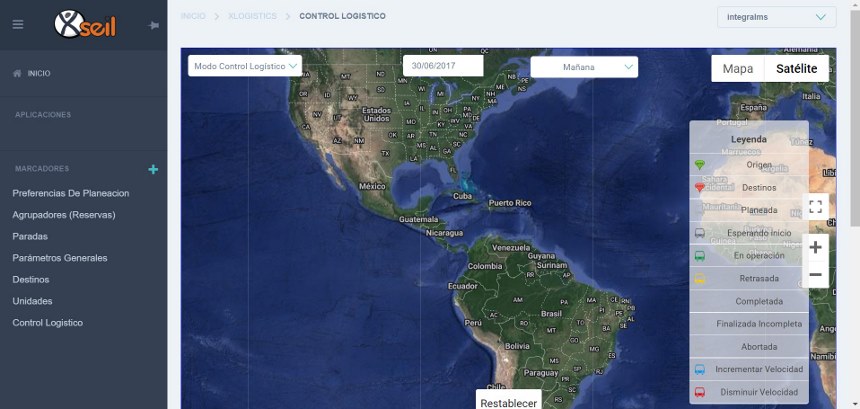
The following images form part of the documentary evidence of the product in operation. A more detailed technical and operational case study is available in Experiencias Xcaret xSeil — Pre-Agentic Logistic Intelligence Before AI Mainstream.
The opportunity
Three structural barriers that existing carpooling models have not solved.
Private vehicles remain unused for much of the day while their owners continue paying financing or leasing, insurance, depreciation, fuel or electricity, parking and maintenance. At the same time, other users pay separately for taxis, ride-hailing, rentals, public transport or vehicle subscriptions.
High user effort
Users must normally publish each journey, negotiate stops, select passengers and agree on payment. In BlaBlaCar, for example, every trip has to be published and negotiated with each interested party, deciding stops and amounts each time. This makes carpooling suitable for occasional journeys, but difficult to use as a dependable daily mobility system.
Insufficient network availability
A shared journey may be available for a regular commute but not for an exceptional or unplanned trip. This uncertainty encourages users to retain their own vehicle even when it is underused.
Scaling complexity — and why this is the hard part
Suppose the previous barrier were solved and a large user network existed, with journeys running in every direction. The system would then have to manage thousands of concurrent routes, which could saturate the system itself.
Current logistics systems do one of two things. They plan rigid routes and timetables, like scheduled lines. Or they close transport slots on demand — Uber with passengers, Amazon with parcel delivery. If no units are available, the job is scheduled for the following day, and the model relies on self-employed drivers making an extra effort at demand peaks.
Semi-rigid policies
It becomes harder still when policies are semi-rigid — almost human considerations of the form electric cars are preferable, but… or a short travel time is preferable, but if a longer route means arriving earlier, then…
This is precisely the class of decision for which xSeil and the Car Evolution algorithms were designed.
The product and the user experience
Coordinated mobility plans, not isolated bookings.
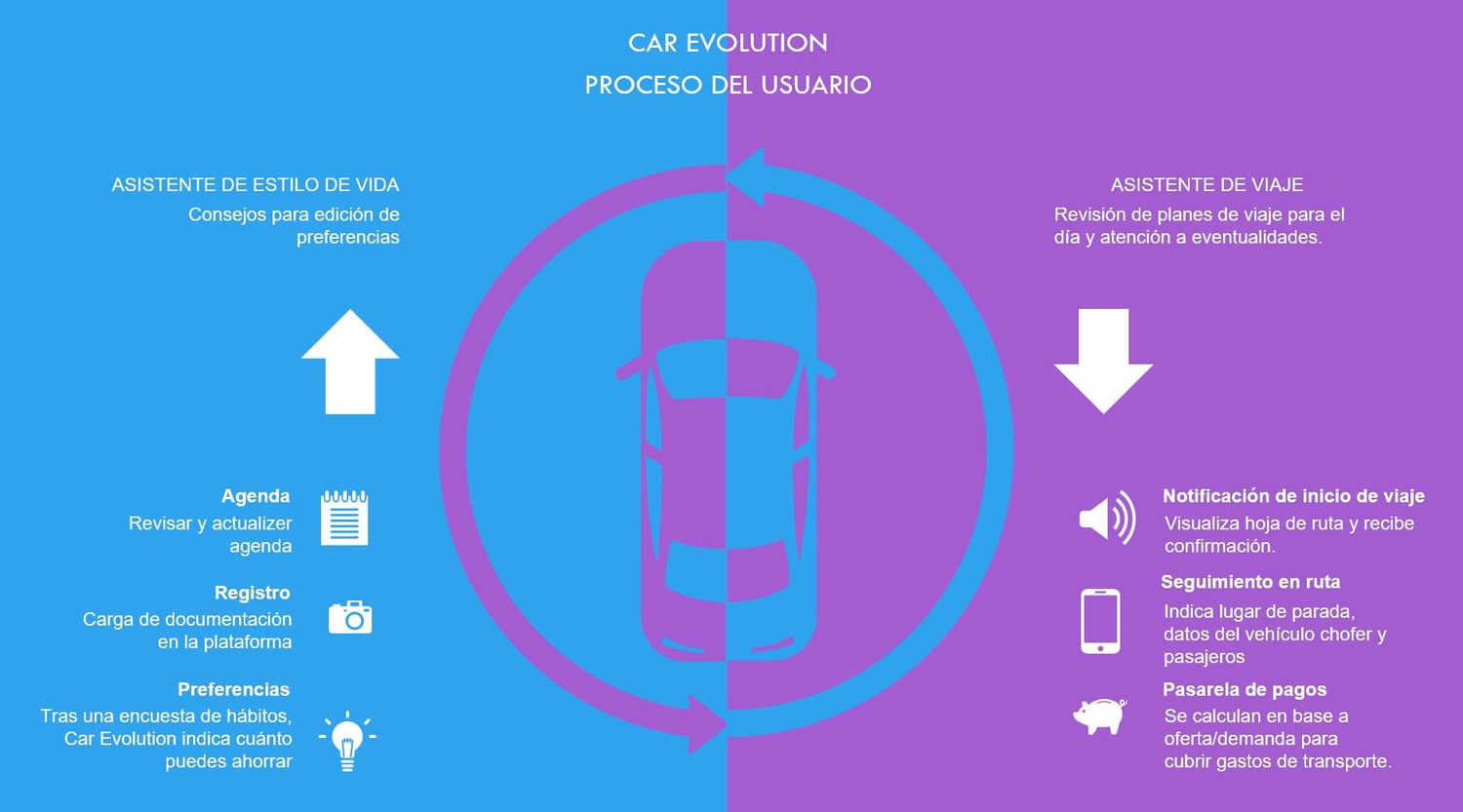
Car Evolution is an AI-assisted mobility orchestration platform that coordinates private vehicles, shared fleets, subscription vehicles and external mobility services around the schedules and preferences of their users. A user can act as a driver, a passenger, or both, depending on the day, time or journey.
The platform analyses recurring and exceptional travel needs, user calendars, willingness to drive, acceptable detours, preferred passengers or compatibility rules, vehicle availability and characteristics, waiting-time limits, service expectations, environmental preferences, and the wider supply and demand across the network. It then generates coordinated mobility plans rather than treating each journey as an isolated booking.
For a driver
A vehicle owner can define when the vehicle is available, when they are willing to drive, maximum extra travel time, acceptable number of stops, passenger preferences, and the amount of vehicle cost they wish to recover. The driver receives a proposed departure time, route, pickup points, expected additional travel time, passenger information and estimated cost contribution.
For a passenger
A passenger defines destination, required arrival time, preferred pickup area, acceptable waiting time, recurring or one-off journeys, accessibility requirements and service preferences. For a user who prefers a chauffeur service — definable for particular hours or days — the application behaves like Uber or Cabify but with automated travel plans: the assistant indicates where to wait, which vehicle will stop, the driver’s name.
Cost allocation and settlement are handled through an integrated payment service according to the accepted mobility plan.
Dynamic orchestration
A live mobility plan, not a route calculated once before departure.
Possible events include traffic congestion, a delayed passenger, an agenda change, a vehicle becoming unavailable, a driver cancelling, a new urgent journey, weather or access restrictions, or demand exceeding available capacity.
When this happens the platform reassesses the affected journey network. It can reassign passengers, change pickup points, alter departure times, combine or separate routes, allocate another available vehicle, modify the order of stops, or activate an external fallback service.
Product architecture
Six layers, coordinating existing mobility resources rather than owning vehicles.
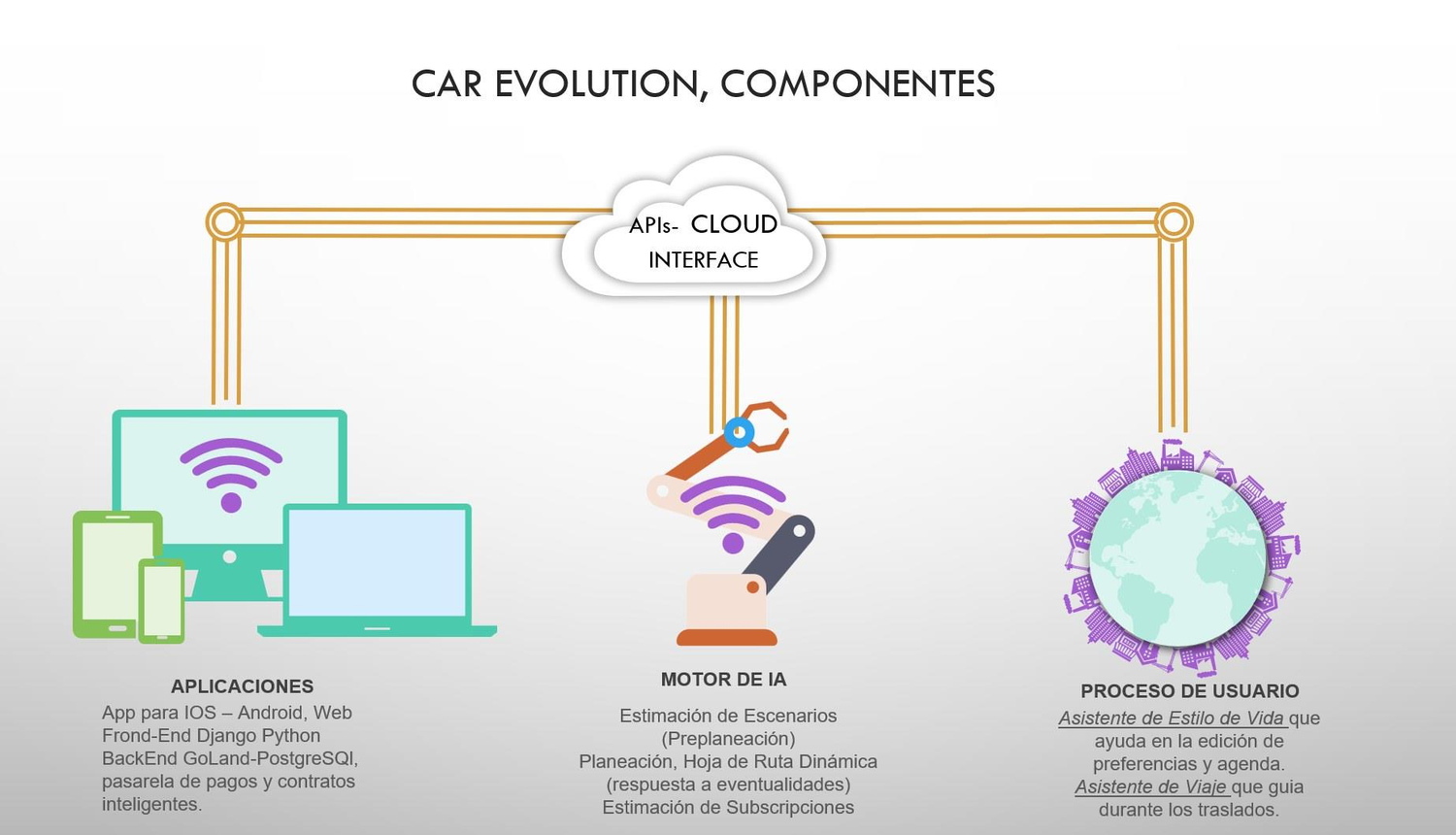
| Layer | Function |
|---|---|
| 1 · User applications | Mobile and web applications provide registration and identity, driver and passenger profiles, calendar and journey management, vehicle registration, preferences and consent, trip proposals and confirmation, real-time notifications, journey tracking, cost allocation and user feedback. |
| 2 · Cloud and API integration | Connects Car Evolution with mapping and routing services, traffic information, user calendars, identity providers, payment services, vehicle-subscription companies, corporate mobility systems, municipal platforms, fleet-management systems and professional mobility providers — so the platform coordinates existing mobility resources rather than requiring ownership of the underlying vehicles. |
| 3 · Mobility context layer | Consolidates current and anticipated travel demand, available vehicles, driver availability, geographic zones, time windows, historical journey patterns, traffic conditions, environmental restrictions, accessibility requirements and service-level commitments. It creates the current operational state used by the orchestration engine. |
| 4 · Forecasting and scenarios | Estimates future journey demand, expected vehicle shortages, network-density requirements, recurring mobility patterns, likely congestion, and when additional subscription or partner vehicles may be required. Compares alternative operating scenarios: lowest emissions, highest punctuality, lowest aggregate cost, shortest travel time, or reduced congestion. |
| 5 · Regime-aware orchestration engine | Manages passenger–driver compatibility, route construction, vehicle assignment, available seat capacity, dynamic priorities, maximum delays, maximum stops, cost distribution, environmental preferences and continuous replanning. Its purpose is to maintain a feasible network under multiple hard and semi-flexible constraints. |
| 6 · Execution and assurance | Once a journey is accepted, controls departure notifications, pickup confirmation, passenger and driver status, journey progress, deviations from plan, cancellations, incident escalation and fallback transport. Where a shared journey becomes impossible, the platform may connect the passenger to an external taxi, ride-hailing or professional mobility provider, with the cost prorated across the users involved. |
Control centre and policy layer
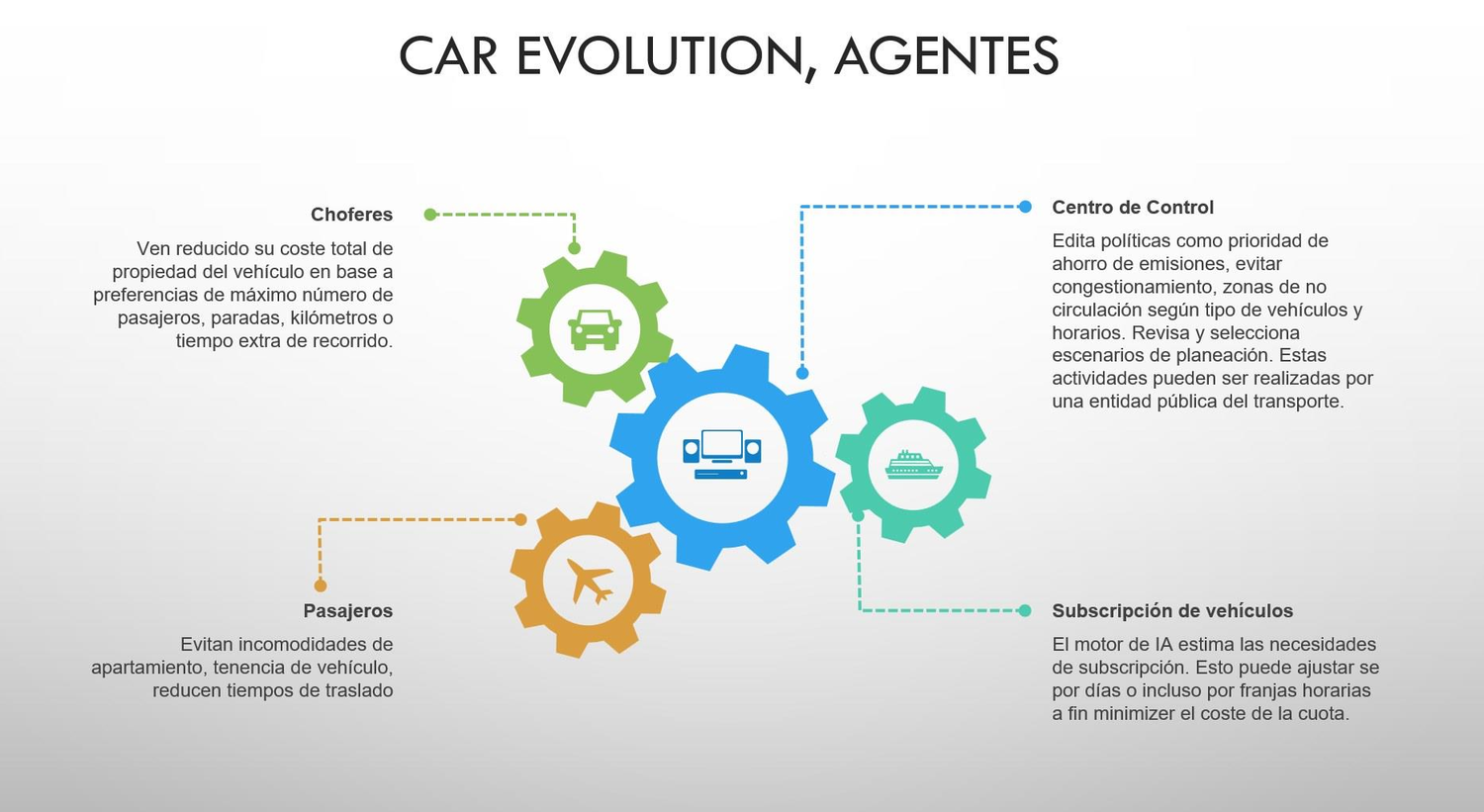
A B2B and institutional product in addition to the end-user application.
Car Evolution can provide an operational dashboard for employers, universities, municipalities, mobility operators, industrial parks, residential communities or tourism destinations.
The organisation can define priorities such as reducing emissions, reducing peak-hour congestion, maximising vehicle occupancy, prioritising electric vehicles, guaranteeing service to selected areas, minimising passenger delay, or limiting total mobility cost. The platform presents alternative scenarios and their operational consequences before a policy is activated — for example, comparing the least-polluting plan against the most punctual and the fastest.
European deployment and adaptation
A proven MVP entering its next commercial and product stage.
Car Evolution does not require a new first prototype to establish that the core product works. The product has already been tested as an MVP at operational scale and can be offered commercially as-is for defined B2B use cases, especially bus and passenger-transport orchestration.
The appropriate next step is a first European deployment inside a bounded mobility ecosystem with recurring journeys and an identifiable user community: a university or research campus, a large employer, an industrial or technology park, a residential development, a municipality with defined commuter corridors, a tourism destination, or a corporate fleet and employee-mobility programme.
This deployment can use the existing orchestration product while adding the adaptations that are commercially convenient for the selected European customer: local regulation, data interfaces, identity and payment services, privacy and security requirements, user-experience localisation, mobility-provider integration and additional capabilities. Autonomous vehicles are not required.
| Area | Included in the first European deployment |
|---|---|
| User and vehicle onboarding | User profiles; driver and passenger roles; vehicle characteristics; availability; recurring schedules; mobility preferences; consent management. |
| Pre-planning | Import or entry of recurring journeys; demand and capacity analysis; initial matching; route generation; cost-sharing estimation; scenario comparison. |
| Daily execution | Trip proposals; confirmation; pickup notifications; route guidance; journey monitoring; passenger–driver coordination. |
| Disruption management | Cancellation handling; traffic-event handling; vehicle reassignment; route adjustment; passenger reallocation; fallback-provider activation. |
| Control dashboard | Active journeys; network utilisation; service exceptions; environmental indicators; journey punctuality; policy configuration. |
| Reporting | Vehicle occupancy; shared-journey rate; avoided kilometres; mobility cost; service reliability; user acceptance; estimated emissions impact. |
Business model
Recurring revenue without owning vehicles.
Platform subscription
Monthly fee per active user, managed vehicle, community or organisational deployment.
Enterprise and institutional licensing
Licensing and support for employers, universities, municipalities, mobility operators, residential developments and tourism ecosystems.
Mobility-partner revenue
Integration, referral or commercial agreements with vehicle-subscription providers, leasing and rental companies, insurance providers, charging networks, taxi operators and ride-hailing services.
Orchestration as a service
API access for mobility companies that already have vehicles, customers or booking channels but lack cross-network planning and dynamic reallocation.
Scalability
Connected, bounded networks rather than immediate city-wide adoption.
Each new deployment adds users, vehicles, mobility patterns, integration partners and reusable configuration knowledge. The platform can later connect several independently operated mobility communities while allowing each one to maintain its own policies, users, data governance, service priorities and commercial arrangements.
Success metrics
European deployments should validate market fit, transferability and commercial repeatability.
| Category | Metrics |
|---|---|
| Operational | Percentage of journeys successfully shared; average vehicle occupancy; journey punctuality; average passenger waiting time; additional driver travel time; cancellation and reassignment rate; replanning time after disruption; journeys requiring fallback transport; platform availability. |
| Resource and sustainability | Avoided vehicle kilometres; reduction in required vehicles; fuel or electricity savings; estimated emissions avoided; improved utilisation of existing vehicles; reduction of empty journeys. |
| User value | Passenger mobility-cost reduction; driver cost recovery; journey acceptance rate; user retention; recurring usage; willingness to pay. |
| Commercial | Revenue per active user or managed vehicle; customer acquisition cost; organisational deployment cost; integration effort; support cost; partner revenue; time required to activate a new community. |
Product, legal and regulatory boundary
A coordination layer, not a replacement for existing mobility services.
Car Evolution is not intended to replace all existing mobility services. It acts as the coordination layer between private vehicles, shared fleets, subscription vehicles, corporate mobility, public-transport interfaces, taxis and ride-hailing providers.
Where a journey has been committed to a passenger and an unresolvable incident occurs, Car Evolution may arrange a taxi, Uber or Cabify, with the cost prorated across all users. This collaborates with those services and provides a guarantee to users. It is a growth-phase function, to be studied and developed rather than assumed.
The model is aligned with Spain’s sustainable mobility law, which is oriented toward encouraging services of this kind in order to reduce overall transport costs and CO₂ emissions. A collaborating public entity can be given a control screen to set policies, with pre-planning showing alternative scenarios for comparison. User documentation and information are stored encrypted, for privacy and for security.
Market conditions
CO₂ reduction commitments and shifting policy leave people uncertain about which new car to buy, and increase the pressure for an effective and efficient answer.
The potential market is large. The approach here is different, the algorithm is already validated in operation, and the team has worked together on developments of this type.
Mobility Operating System: policy-driven control already demonstrated
The control centre did not merely display routes. It governed the operational rules, priorities and trade-offs under which the entire mobility network was planned, executed and reconfigured.
The description Mobility Operating System is not a new marketing label applied retrospectively to a conventional route optimiser. The xSeil architecture combined a web-based command-and-control core, mobile field execution, data integration and cleansing, operational master data, planning and optimisation, real-time monitoring, dynamic coordination, and managerial intelligence across the full passenger-transport lifecycle.
In operational terms, the control centre acted as the policy and decision layer between management objectives and field execution. It converted organisational rules, service commitments, fleet conditions and live network pressure into executable vehicle, passenger and route decisions.
Dynamic access, zone and route policies
The operating model already supported policies defining which types of vehicles could be assigned to particular hotels, services, zones, routes or destinations, and under which time or operating conditions. The underlying operational model included vehicle categories, hotel and park routes, service types, zones, transfer points, geofences, pickup windows, slow-transit periods, saturation conditions and special service rules.
These elements were not treated as passive reference data. They participated directly in feasibility and assignment decisions. A vehicle could be operationally suitable in one part of the network and unsuitable in another because of its type, role, capacity, service configuration, access policy, maintenance status, timing or the current route regime. When the state of the operation or an authorised policy value changed, the planning and coordination layers could reassess the affected assignments and route structures.
Access and zone governance
Permitted or restricted operating areas, geofences, destination and hotel rules, time windows, route-specific conditions and access by vehicle type.
Vehicle-use policies
Vehicle category, capacity, operational role, availability, maintenance condition, rented or owned status, service suitability and special passenger requirements.
Route and service rules
Maximum stops, direct-trip preferences, transfer-centre policies, pickup and arrival commitments, journey duration, saturation logic and special-service parameters.
Live policy application
Policy values were applied to the current operational state rather than evaluated only once in an offline plan, allowing affected assignments to be reviewed as conditions changed.
Preferences and policy values that change with the operating state
The platform distinguished between hard constraints, which could not be violated, and soft or semi-flexible policies, whose relative importance depended on the current situation. Capacity, feasibility and committed service could operate as prohibitive boundaries. Other goals — such as reducing fuel consumption, limiting stops, using a preferred vehicle type, avoiding transfers or protecting a particular punctuality measure — could become more or less important as pressure moved through the network.
The system did not rely on one permanent ranking of objectives. The value or operational “price” of a policy could change dynamically. A vehicle preference that was strong under normal conditions could become secondary during disruption; avoiding a transfer centre could be desirable at one moment and counterproductive when route saturation or arrival congestion increased.
This dynamic valuation is essential to the Mobility Operating System concept. Management did not have to pretend that every policy was equally important at every moment. The platform could interpret the current regime, compare the marginal operational cost of competing objectives and select an executable balance while preserving non-negotiable commitments.
A pool of simultaneous operational objectives
xSeil was designed to manage a pool of interacting objectives, not to optimise a single metric in isolation. Depending on the service and operating context, the active objective set could include:
Environmental efficiency
Fuel consumption, CO₂-related vehicle and route policies, empty movement, unnecessary mileage and the use of more suitable vehicle categories.
Policy compliance
Access restrictions, permitted vehicle types, service rules, special passenger conditions, direct-trip and transfer-centre policies.
Time commitments
Pickup punctuality, destination-arrival punctuality, maximum tolerable delay, journey duration and the protection of committed service windows.
Network congestion
Avoiding congestion on selected corridors, transfer points or destination entrances, and distributing arrival flows rather than optimising each route independently.
Capacity and utilisation
Vehicle occupancy, number of units, available seats, fleet readiness, rented capacity and sufficient operational slack to absorb disruption.
Service quality
Number of stops, directness, transfers, passenger grouping, compatibility, route quality and the distribution of scarce service quality across committed passengers.
The purpose was not to achieve a theoretical optimum for one indicator. It was to keep the complete system feasible, balanced, explainable and operationally acceptable under continuous change. Hard constraints invalidated unacceptable solutions; semi-flexible objectives were balanced according to their current operational value.
Closed-loop command, execution and reconfiguration
The control centre connected planning with actual field execution. It could compare planned routes, assigned vehicles and promised pickup times with real vehicle positions, actual boarding, observed punctuality and operational incidents. Deviations could then trigger route-sheet updates, passenger redistribution, transfer coordination, vehicle or personnel reassignment and revised execution instructions.
This closed loop is what distinguishes an operating system from a static planning application. The platform did not stop after producing a route. It maintained a shared operational state, applied policies to that state, observed execution and changed the plan when the real network diverged from expectations.
Why this matters for Car Evolution
Car Evolution carries this control-centre logic into a wider shared, corporate, urban and multimodal mobility environment. The product proposition is therefore not limited to passenger–driver matching. Its deeper capability is to allow an organisation to express mobility policies and objectives, evaluate alternative network configurations, execute the selected plan and adapt it as demand, vehicles, incidents and priorities change.
Technical basis: JUBAP.Net © xSeil Whitepaper — Experiencias Xcaret Logistics.
From underused vehicles to one adaptive network
Car Evolution enters Europe with a product already tested as an MVP at operational scale and with a demonstrated command-and-control architecture. Its operating core already managed policy-dependent vehicle and route access, changing preferences and priorities, multiple simultaneous objectives, live execution monitoring and dynamic reconfiguration. It can be offered commercially as-is for defined B2B bus and passenger-transport orchestration use cases.
Immediate business value: lower user cost · higher vehicle utilisation · reduced congestion and emissions · more reliable shared mobility.
European product opportunity: adapt and extend the existing product for local regulation, integrations, user experience and additional mobility capabilities, creating a repeatable European deployment model.
Startup stage: an existing and evidenced product, a credible initial market offer, and a clear path from proven MVP to European traction and scalable productisation.
OÜ JUBAP is the legal entity; JubAp.EU is its commercial name. For legal, commercial and copyright purposes JubAp.EU and OÜ JUBAP are the same legal person; unless otherwise stated, all rights associated with JubAp.EU are owned by or legally represented through OÜ JUBAP.
JubAp.EU — OÜ JUBAP (Estonia) · Registry code 16941644 · Akadeemia tee 42-11, Tallinn, Estonia · info@jubap.eu · jubap.eu/legal-notice
The historical frontier-engineering lineage is documented through JubAp.Net. Tegrity.AI is the research and publication circle of The Integral Management Society (Geneva, Switzerland). Scientific formalisation and publication take place there; applied research, engineering and productisation take place here.
Named organisations indicate project experience and do not imply their endorsement of this document or of OÜ JUBAP’s current product claims. This page describes an existing mobility-orchestration product that has been operationally tested as an MVP at scale, including a policy-aware command-and-control core, live execution monitoring and dynamic operational reconfiguration. It can be commercially deployed for defined use cases in its current form. European deployment may require customer-specific configuration, local integrations, regulatory adaptation and selected capability extensions; these activities extend and productise the existing product and do not represent its first implementation. Forward-looking European pricing and market assumptions remain to be validated.