
Federating Manufacturing Capabilities Across Centuries-Old Luxury Maisons
Industrial Case / Manufacturing Rationalization / Enterprise Architecture / Capability Federation
Context
A global luxury group needed to rationalize manufacturing technologies across several high-end watchmaking Maisons, some with histories reaching close to three centuries.
This was not a standard manufacturing rationalization exercise. The environment combined ultra-precision mechanical engineering, centuries of accumulated know-how, highly differentiated manufacturing cultures, local proprietary tools, CNC, CAD/CAM, quality-control and IoT systems, low-code shopfloor applications, legacy devices and deeply specialized calibration processes.
In haute horlogerie, manufacturing technology is not a secondary support layer. It is part of the Maison’s industrial memory.
Business Challenge
The initial question appeared simple: can manufacturing capabilities and technologies be rationalized across the group? The reality was considerably more complex.
Each Maison had developed its own manufacturing logic, its own tooling, its own local applications and its own ways of preserving critical know-how. Some capabilities looked redundant from a global portfolio view, but were actually deeply connected to local manufacturing precision, historical constraints, product identity or proprietary engineering practice.
In this environment, rationalization could not be approached as simple application reduction. The real challenge was how to create architectural convergence across highly specialized manufacturing environments without destroying local know-how, precision or production continuity.
Manufacturing Complexity
Watchmaking manufacturing operates at an exceptional level of engineering precision. The integration of CNC, CAD/CAM, quality-control systems, IoT devices and production applications must support components of extreme mechanical accuracy, often assembled into highly complex movements where small deviations affect the final product.
To place a CNC machine into production in this environment requires approximately double the qualification time compared to aerospace manufacturing, given the tolerances, the number of interdependent components and the depth of quality-control cycles required. The data volumes generated between machines, quality-control systems and shopfloor applications are substantial — in some respects comparable to high-frequency financial infrastructure in terms of throughput and precision demands.
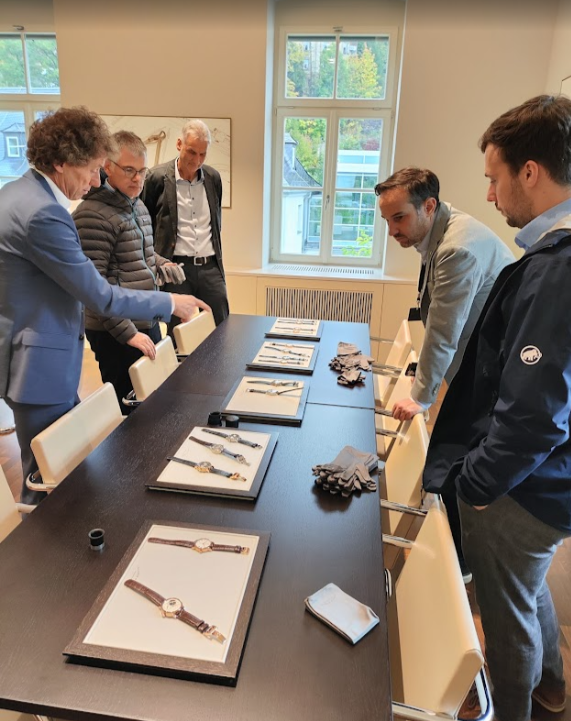
The work required visiting and understanding the manufacturing environments directly, not only reviewing applications from a central inventory. It required understanding workshop flows, machine dependencies, ergonomics, legacy integrations and the relationship between craft and technology in each location.
The Core Discovery
The most important discovery was that manufacturing rationalization cannot start with forced standardization.
Different Maisons used different production models. Some worked with more sequential flows, where specialists contributed to different stages of the same watch. Others preserved models where a highly skilled expert remained closely connected to the full assembly logic of a piece. Some focused primarily on metal components; others worked with gold, precious materials or highly specific finishing processes.
These differences were not inefficiencies by default. They were often part of the manufacturing identity. The real work was distinguishing between legitimate local differentiation, historical know-how worth preserving, duplicated technological capabilities, uncontrolled local development, security exposure and genuine opportunities for architectural convergence.
Example: Proprietary Calibration Know-How
One of the clearest illustrations came from a German watchmaking environment. Highly complex calibration know-how — including double tourbillon and other advanced complications — had been developed locally, independently from the traditional Swiss ecosystem, because that expertise could not simply be imported. What began as a constraint became a central manufacturing capability. Over time, it became embedded in proprietary technical logic, including locally developed software.
From a rationalization perspective, this distinction is critical. A central architecture team might be tempted to classify such a system as a local application or a technical exception. In reality, it may contain unique industrial intelligence that defines competitive advantage. This is why rationalization in haute horlogerie requires capability analysis, not only application analysis.
The Low-Code and No-Code Challenge
One of the most important architectural challenges was the rapid growth of low-code and no-code manufacturing applications. On the shopfloor, the attraction is immediate: a team can create a small application, component or workflow in a few hours to solve a real operational problem.
But over time, this can generate hundreds of local applications with unclear version control, fragmented ownership, weak repository discipline, duplicated logic and difficult dependency tracking. In manufacturing, this is especially sensitive because these applications may be directly connected to production processes, quality control, machine data or IoT environments. The issue is not that low-code is wrong.
The issue is that low-code in manufacturing requires architecture, governance and lifecycle control from the beginning — something that is rarely in place when adoption is organic and fast.
Legacy and IoT Risk
The manufacturing environment also included devices and systems that were highly valuable but technologically constrained. Some depended on legacy operating systems. Others were deeply embedded in production processes and could not be replaced without careful analysis of their dependencies.
In several cases, a rationalization attempt around what appeared to be a single system revealed accumulated complexity: patches, historical data, local interfaces and rollback constraints that had been building for years or decades. One system could effectively become several systems once the full dependency map was understood. This is why manufacturing rationalization requires humility: the apparent low-hanging fruit is often not low-hanging at all.
The Approach: Capability Federation
The successful approach was not immediate standardization. It was capability federation.
The objective was to create visibility and convergence across Maisons while respecting the specificity of each manufacturing environment. This included mapping manufacturing capabilities, understanding local technologies and applications, identifying duplicated or similar capabilities, distinguishing true uniqueness from avoidable fragmentation, creating communities of practice and defining convergence roadmaps.
The group included different technical stacks and local practices across its Maisons: .NET, Delphi, RPA, low-code platforms, Python-based proprietary tools, CAD/CAM environments and IoT systems. In some cases, the same capability had been implemented differently across Maisons. The rationalization opportunity was not always to retire one system immediately.
More often, the better path was to define reference architectures, target technology families, convergence roadmaps, shared governance, reusable patterns and communities of practice between manufacturing teams.
Key Lesson: Manufacturing Rationalization Is a Long-Cycle Transformation
The central lesson of this engagement was: in precision manufacturing, rationalization often requires investment before savings appear.
This is different from other enterprise environments where a quick application cleanup can produce immediate results. In haute horlogerie manufacturing, systems are deeply connected to production continuity, quality, know-how and industrial identity. Therefore, rationalization requires discovery, trust, architecture, capability mapping, security review and gradual convergence. The returns can be strong, but they are not usually immediate.
Teams that are highly practical, engineering-minded and close to the physical process are excellent partners in this kind of work — but the timescales must be respected. Attempting to accelerate convergence before the capability landscape is properly understood is one of the most common failure modes in manufacturing rationalization.
Outcome
The engagement established a first manufacturing rationalization approach across several high-end watchmaking Maisons. It showed that architectural convergence was possible, but only through a federated model that respected precision engineering, historical know-how, manufacturing culture, local tools, production risk and long-term capability preservation.
The result was not a quick cleanup exercise. It was the creation of a realistic path toward manufacturing technology convergence inside one of the most demanding industrial environments in the world — laying the foundation for communities of practice, shared architectural roadmaps and gradual convergence across manufacturing teams that had been operating independently for generations.